
How Master Planning Creates Communities That Endure
A case study in disciplined planning, open space systems, and long-term community identity
Before a community takes shape, there is only land. Master planning is the discipline that transforms that land into a place with identity, purpose, and long-term market value.
For developers, builders, and landowners, that early framework matters more than any isolated feature introduced later. It determines how land use, circulation, density, infrastructure, and open space work together as one system. It also establishes the structure that allows a community to grow, adapt, and remain recognizable over time.
At its best, master planning does more than organize a site. It defines how people will experience the land every day: where neighborhoods gather, how trails and parks shape movement, what character a place expresses, and how that identity holds as the project evolves.
That is where disciplined planning and design begin to separate enduring communities from forgettable ones.
Why Master Planning Matters
Master-planned communities succeed when vision is supported by structure. Without that structure, even strong ideas begin to erode as entitlement, phasing, infrastructure, and market realities take hold.
A strong master plan creates clarity in several ways:
- It organizes complexity early. Roads, open space, development parcels, and amenities are resolved as part of one framework instead of a collection of unrelated decisions.
- It protects identity over time. Character is not layered onto the project later. It is embedded within the planning logic from the beginning.
- It improves daily experience. Parks, trails, entries, and neighborhood connections are positioned to support real movement, recreation, and social life.
- It supports long-term market performance. Communities that feel clear, connected, and intentional are better positioned to hold value as they build out.
For ABLA, this is the core of planning in practice: translating vision into an actionable framework and carrying that framework forward through implementation with continuity and discipline.

Planning in Practice: Soleo
Soleo in San Tan Valley, Arizona, demonstrates how master planning, landscape architecture, and community identity can be structured together from the start.
Project Snapshot
Location: San Tan Valley, Arizona
Size: 473 acres
Homes: 1,400
Clients: Tri Pointe Homes, W Holdings
Services: Land Planning, Entitlement Services, Master Planning, Site Planning, Landscape Architecture, Character and Theming, Marketing Trail Visualization, Signage Master Planning, Construction Services
A Community Organized Around Open Space
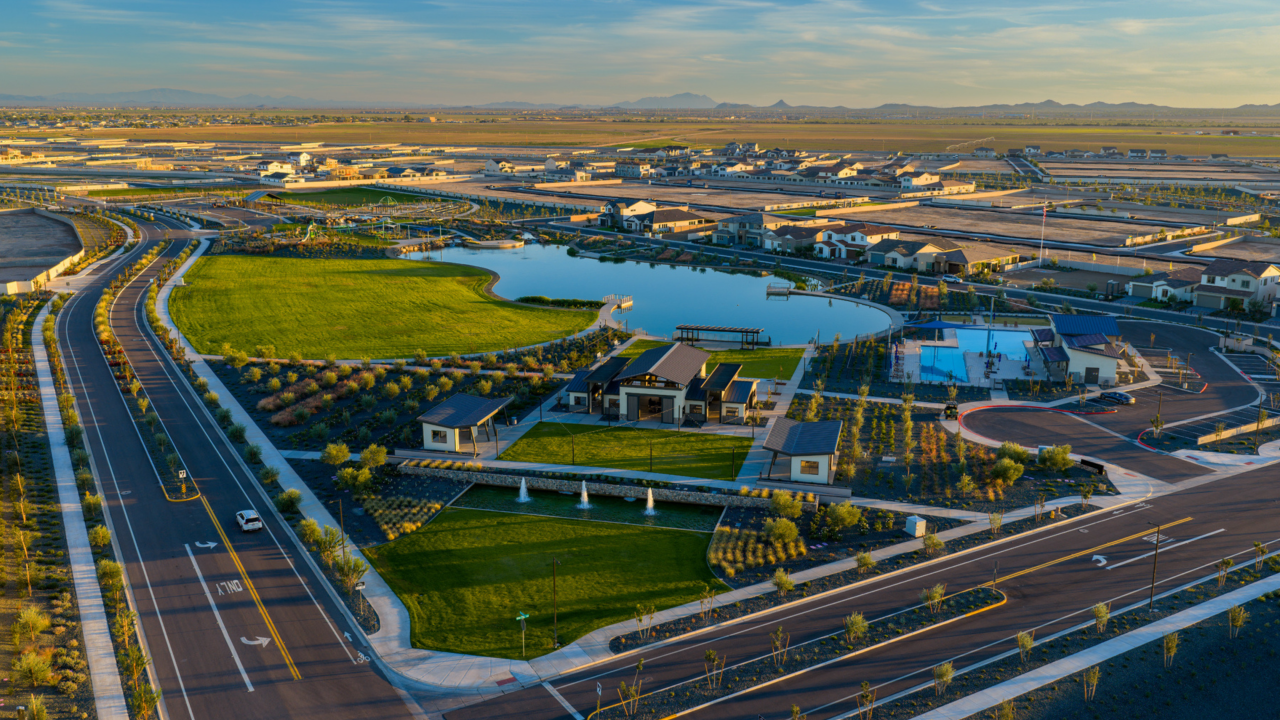
At Soleo, the community is organized around open space rather than treated as a collection of isolated neighborhoods. Planned trail networks connect parks, residential areas, and shared amenities into a continuous system that supports walkability, recreation, and everyday connection.
That matters because movement is not defined by streets alone. When trails, parks, and neighborhoods are planned together, the result is a more legible and livable community experience.
Arrival as Part of the Framework
The structure of Soleo is also felt in the sequence of arrival. As residents move from surrounding arterial roads into the community, the experience shifts into shaded streets, curved roadway geometry, and open space that slows the pace and introduces a distinct neighborhood rhythm.
This transition does more than improve aesthetics. It establishes a clear sense of entry and helps move people from regional infrastructure into a place with its own identity.
Amenity Design That Extends the Plan
At the center of the community, a 3,500-square-foot open-air amenity building reinforces the connection between planning and experience. Designed as a non-conditioned structure, it extends communal life outdoors and supports a lifestyle centered on wellness, sustainability, and social interaction.
A central lake anchors the amenity area, serving both as a visual focal point and as part of the irrigation system that supports the broader landscape framework. In that way, the amenity is not separate from the plan. It is a direct extension of it.
Character Rooted in Place
Soleo draws from Napa Valley-inspired agricultural design, using restrained forms, honest materials, and careful detailing to create an environment that feels elevated without becoming overworked.
That character is reinforced through planting patterns, parks, streetscapes, and entries that establish hierarchy, rhythm, and continuity across the community. The result is not a themed surface treatment. It is a coherent identity expressed through both planning and design.
What Developers Can Learn from Soleo
The Soleo example highlights several principles that apply broadly across successful master-planned communities:
- Open space should be treated as organizing infrastructure, not leftover land.
- Arrival should be considered part of the planning framework, not just an entry feature.
- Amenities should reinforce the larger system and support daily use, not stand apart from it.
- Community identity is strongest when planning and landscape architecture operate together from the beginning.
- Long-term value is protected when structure and design remain aligned through implementation.
These are not aesthetic preferences. They are planning decisions that influence clarity, usability, and long-term performance.
The Value of Disciplined Planning
Master planning is most effective when it does more than arrange land. It should establish how a community functions, how it will be experienced, and how its identity will endure as real-world conditions begin to shape it.
That is what disciplined planning and integrated design make possible. They create communities that are clear in identity, connected in experience, and resilient in the market.
At ABLA, that work begins early and continues through implementation so the original vision can hold under real conditions — not only on paper, but in the built environment over time.